June 3, 2026
If you own a home or land anywhere around Chesnee, you’ve already figured out that trees here grow fast and grow big. The Carolina Piedmont gets enough rain, enough warmth, and enough decent soil that pines, oaks, and maples can put on serious size in a hurry. The downside is that most homeowners don’t notice their trees becoming a problem until something visible goes wrong – a limb on the roof, a crack down the trunk, a tree leaning over the driveway after a storm.
By then, the cheap version of the fix has already passed. What used to be a $400 trim turns into a $3,500 emergency removal, and your insurance deductible might be in the mix on top of that.
Here are three signs that show up well before that point. If you see any of them on your property, it’s time to bring in a pro.
1. Dead Wood You Can See From the Ground
Dead branches in the canopy are the most common warning sign, and they’re also the easiest to miss because most people don’t look up. Walk around your trees and actually study them. You’re looking for branches that are bare while the rest of the tree is leafed out, branches with peeling or missing bark, or branches that snap dry instead of bending.
On hardwoods like oaks and maples, dead wood often shows up as completely bare limbs sticking out at odd angles from an otherwise full canopy. On pines, you’re looking for whole sections that have gone brown or rust-colored while the rest of the tree is still green. A few small dead twigs are normal – most trees self-prune to some degree. But once dead branches are more than a couple inches in diameter, or once you’re seeing them in multiple spots, the tree is telling you something.
Why it matters
Dead branches are the first thing to come down in a storm. They’ve already lost their flexibility, and they often have rot working through them where they attach to the trunk. A thunderstorm with 40 mph gusts – which the Upstate gets multiple times every summer – is more than enough to drop a dead limb on whatever’s underneath it. That includes roofs, cars, fences, and people.
There’s also a tree health angle. Dead wood doesn’t heal. It just sits there as an entry point for fungus and insects, which can spread back into the living parts of the tree. Removing dead limbs early protects the rest of the canopy.
What a pro will do
A proper deadwood removal – sometimes called “crown cleaning” in the trade – takes out the dead and dying branches with cuts placed just outside the branch collar so the tree can seal them off. It’s not the same as cutting random branches off with a pole saw from the ground, which usually leaves stubs that rot. Done right, the tree looks more or less the same when the crew leaves, but it’s safer and healthier.
2. Branches Touching or Hanging Over Your House
This one is so common in Chesnee that most homeowners stop noticing it. Limbs scrape against siding, brush the roof, or hang ten feet over the gutter – and because it’s been that way for years without anything dramatic happening, it gets ignored.
The problem is what those limbs do over time, not all at once.
What overhanging branches actually cause
- Roof damage from constant scraping during wind. Asphalt shingles lose their granules where branches drag across them, and the spot eventually leaks.
- Clogged gutters and rotted fascia. Leaves and small twigs pile up in gutters faster than anyone can keep up with, and once water backs up under the roofline, you’ve got a real repair coming.
- A bridge for pests. Squirrels, rats, and carpenter ants use overhanging limbs as a highway into the attic. Once they’re in, they’re hard to get out.
- Moisture problems on siding. Branches that touch siding hold moisture against it and grow algae and moss. That accelerates rot on wood siding and stains vinyl.
- Major damage in storms. When a tree comes down, the limbs over the house come down with it. Trimming them back well in advance means the tree might still fall, but it’s far less likely to hit anything important.
The clearance rule of thumb
Most arborists recommend keeping branches at least 6 to 10 feet away from the roof on all sides, depending on the species. Fast-growing trees like loblolly pine and silver maple need more clearance because they put on growth faster. Slow-growing oaks can usually be trimmed less frequently. A professional will look at how fast your specific tree is growing and recommend a schedule – usually somewhere between every 2 and 5 years.
Why DIY rarely works here
It’s tempting to grab a pole saw and handle this yourself, and for very small limbs (under an inch or two, within easy reach from the ground), that’s fine. But once you’re talking about real limbs – anything thick enough to actually matter – you’ve got two issues. First, the limb weight will pull the cut wrong and tear bark down the trunk, which damages the tree. Second, working overhead with a saw, on a ladder, near a structure, is one of the most reliable ways to end up in the ER. Tree work injuries are common and ugly. This is the kind of job where paying a crew is just cheaper than handling it yourself.
3. Mushrooms, Soft Spots, or Cracks at the Base of the Trunk
This is the sign that most homeowners completely miss, because it requires looking at the bottom of the tree instead of the top. But if you’re seeing any of these three things, it’s a serious warning that the tree’s structural integrity is failing from the ground up.
Mushrooms or fungal growth at the base
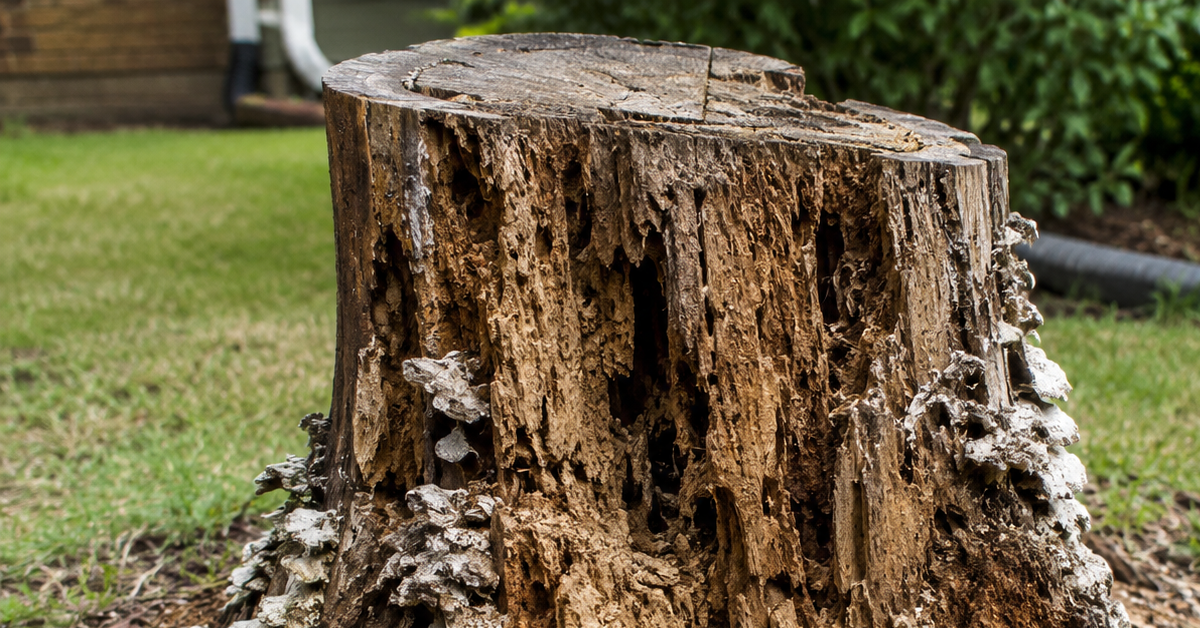
Conks, shelf fungi, or clusters of mushrooms growing on the trunk or out of the soil right next to the trunk are usually a sign that root rot or trunk rot is already well underway. The visible mushroom is just the fruiting body – the actual fungus is inside the wood, breaking it down. By the time you see mushrooms, decay has usually been working for years.
Common culprits in the Upstate include Armillaria root rot, Ganoderma (which produces big shelf-like conks), and various Hericium species. The species matters less than the message: this tree is rotting, and the part you can’t see is worse than the part you can.
Soft, spongy, or hollow-sounding wood
Tap the base of the tree with the back of a hatchet or a small rubber mallet. A healthy hardwood gives back a solid, almost ringing thunk. A tree with significant interior decay sounds hollow – duller, more drum-like. You can also feel it. If your hatchet sinks into the wood instead of bouncing off, that’s bad.
Pines should sound solid too, though they’re a bit softer-toned than oaks. Either way, hollow is bad.
Vertical cracks running up the trunk
A vertical crack or split in the trunk – especially one that’s open enough to see into – usually means the tree is splitting under its own weight or has been stressed by wind in a way that’s about to fail. Some shallow surface cracks in older bark are normal, especially on certain species. But a crack you can stick a finger into, or one that’s clearly growing, is a structural problem.
What happens if you ignore these
A tree with significant root or trunk decay can come down without any storm at all. They fall on still summer afternoons. They fall at night while everyone’s asleep. They fall during routine rain. The whole point of structural decay is that the tree is no longer holding itself up – it’s just waiting for any little thing to push it over.
If the tree is anywhere within falling distance of your house, your driveway, a road, or where people walk, this is the most urgent of the three warnings on this list. Get a professional out to look at it as soon as possible.
What a Maintenance Visit Actually Looks Like
If any of the three signs above sounded familiar, the next step is a real inspection. A professional walk-through usually takes 20 to 45 minutes, depending on how many trees are on the property. The arborist looks at each tree from multiple angles, checks the base and root zone, evaluates the canopy, and gives you an honest read on each one.
Most properties don’t need every tree worked on. A good crew will tell you which trees are fine, which ones need attention this year, and which ones can wait until next year. The estimate covers all of it in writing, so you can plan.
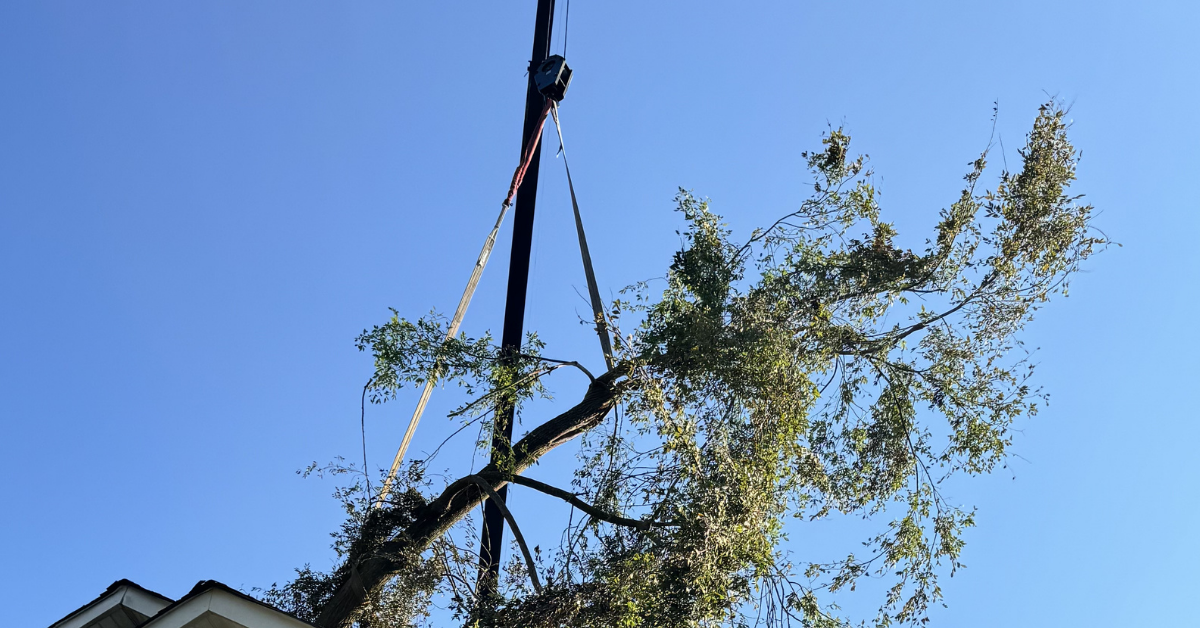
In Chesnee and the surrounding parts of Spartanburg County, the cost for a routine maintenance visit varies a lot based on what’s needed. A simple deadwood trim on a single tree might run a few hundred dollars. A full property with eight or ten trees needing attention can run into the low thousands. Big hazardous removals – especially crane-assisted ones – are their own category.
The best way to find out is to get a quote. At Warrior Tree Service, estimates are free, and the price we quote is the price you pay – no surprise add-ons at the end.
The Real Math on Tree Maintenance
Most homeowners hesitate on tree work because of cost. The thing is, the cost of doing nothing is almost always higher in the long run. A few examples we see regularly:
- A $500 deadwood trim, skipped – becomes a $2,800 limb-on-roof emergency call plus a roof repair.
- A $700 clearance trim away from siding, skipped – becomes a $4,000 siding-and-fascia repair five years later.
- A $1,200 hazardous tree removal, postponed – becomes a $6,000 emergency removal after the tree falls on the garage.
Tree maintenance is one of those things where being even a year early is far cheaper than being a month late. If you’re seeing any of the warning signs above on your Chesnee property, don’t sit on it.
Get a Free Tree Removal Quote
Call Warrior Tree Service at (864) 660-7995 for a free on-site inspection. We’ll walk the property with you, point out what we see, and give you a written estimate with our no-surprise guarantee. If your trees are fine, we’ll tell you that too – there’s no upsell and no pressure.
We’re locally based in Chesnee and we serve all of Spartanburg County plus Cherokee and Greenville. Licensed, insured, family-owned, and we answer the phone 24/7 for emergencies.