June 3, 2026
Almost every limb failure we get called out for after a Spartanburg thunderstorm has the same cause: a weak branch union that finally gave out. The storm gets blamed, and the wind certainly didn’t help, but the structural defect was usually there for years before the limb came down.
The good news is that weak branch unions are visible. You can spot most of them from the ground with no special training, and the ones that look suspect can be addressed before storm season turns them into a problem. Here’s what to look for and what to do about it.
What a Branch Union Is, and Why Some Are Weak
A branch union is the spot where a branch joins another branch or the main trunk. On a healthy tree, that union is reinforced by overlapping wood fibers from both sides – basically, the tree is laminated together at the joint, like plywood. Strong unions can carry enormous loads and flex in wind without failing.
A weak union is one where that lamination didn’t form properly. Instead of wood fibers interlocking across the joint, bark gets trapped in between. The two pieces are still connected, but they’re held together more by friction and outer growth than by structural wood. That’s called “included bark,” and it’s the single most common cause of major limb failure in the Carolinas.
Other weak unions come from poor pruning (especially topping cuts), storm damage that left a partially broken limb in place, or species that just naturally produce weak forks – Bradford pears being the textbook example.
The Five Warning Signs of a Weak Union
Walk around each major tree on your property and look up. You’re looking for these specific patterns at the spots where major limbs come off the trunk or where the trunk forks.
1. Tight V-shaped forks
This is the big one. When two limbs (or two trunks) come together in a tight V – meaning the angle between them is less than about 40 degrees – there’s a very high chance of included bark. The narrow angle physically prevents the two sides from laminating together properly as they grow.
Compare against a healthy U-shaped union, where the angle is wider (more like 60 to 90 degrees) and the two pieces flow into each other with a smooth, rounded crotch. U-shaped unions are strong. V-shaped unions are not.
If you see a tight V on a major limb, especially one over the house, the driveway, or a power line, that’s a candidate for either cabling or removal of the weaker side. Don’t wait for a storm to make the decision for you.
2. Bark visibly turned inward at the union
Look closely at the crotch where the branch meets the trunk. On a healthy union, the bark forms a raised ridge – sometimes called the “branch bark ridge” – that runs from the top of the union down both sides of the joint. It looks like a seam or a small ridge of pushed-up bark.
On a weak union with included bark, you’ll see the opposite. Instead of a ridge pushing out, the bark sinks inward, forming a crease or a dark line that runs down into the union. The deeper that crease, the more included bark is trapped inside, and the weaker the connection.
3. Cracks or splits in the union itself
Any visible crack or split running through a branch union is a serious warning. Cracks mean the union is already starting to fail – wood fibers are tearing under load – and it’s a matter of when, not if, the limb comes down.
Some cracks are obvious. Others are subtle and only show up when you really look. Check for cracks running outward from the center of a fork, cracks on the underside of a major limb where it attaches, or any darker line that looks deeper than normal bark texture.
4. Two trunks roughly the same size growing from one point
This is called a codominant stem, and it’s a setup for failure. When a tree has two main trunks that are about equal in diameter coming from the same base, neither one is acting as the dominant leader. Both trunks are competing, and the union between them is almost always weak – usually with included bark, often with cracking already starting.
Codominant stems are extremely common on Bradford pears, silver maples, ornamental cherries, and certain oaks that got topped or damaged when young. If you’ve got a tree with two equal trunks coming from low on the tree, especially if it’s tall, that’s a high-risk structure. In a major thunderstorm or ice event, one side often shears off and takes a huge chunk of the tree with it.
5. Excessive weight on one side of a union
Even a union that looks structurally okay can fail if the weight load on it is wrong. If you’ve got a major limb that’s grown long and heavy, sticking out at a low angle from the trunk, gravity is constantly pulling on that union. Add wet leaves, ice, or a strong gust, and the load multiplies.
Limbs that have been allowed to grow out laterally without proper pruning often end up with way more weight than the union was designed to carry. The fix is usually a weight-reduction prune – shortening the limb so it carries less leverage – not removing the whole limb. A pro can do this without ruining the look of the tree.
Which Trees in Spartanburg Are Most Prone to Weak Unions
Some species are far more likely to develop weak unions than others. If you’ve got any of these on your property, they deserve extra scrutiny:
Bradford and Callery pears
These ornamental trees are notorious. They grow fast, they bloom beautifully in spring, and they almost always develop a tight cluster of codominant stems that come apart in their teens. If you’ve got a Bradford pear that’s 15 to 25 years old and you haven’t had it structurally pruned, expect it to start splitting up during the next major storm. The classic Bradford failure is one entire side of the tree splitting off and taking half the canopy with it.
Silver maple
Fast-growing, weak-wooded, and prone to codominant stems and included bark. Silver maples that have gotten large are some of the most common storm-failure trees in the Upstate.
Tulip poplar
Tall, fast-growing, and brittle. Tulip poplars often grow with weak unions that fail under wind load, especially once the tree gets above 60 or 70 feet.
Bradford pear’s cousins and most fast-growing ornamentals
Most ornamental trees bred for fast growth and showy form have structural issues. If a tree was sold to grow fast, it almost certainly has weaker wood and weaker unions than slower native species.
Loblolly pine
Pines don’t usually have classic branch-union problems, but they do have their own version – major limbs that attach with a lot of included bark on fast-grown trees. Storm-damaged pines often shed huge limbs from the lower canopy.
What to Do Once You’ve Found a Weak Union
Don’t panic. Not every weak union is an emergency. Some are slowly developing problems that can be managed with proper care. Others are urgent. The next steps depend on what you found.
For minor weak unions on small or low-stakes trees
If the tree is small, not over a structure, and the union isn’t actively cracked, the right move is usually a structural prune. A trained arborist can selectively reduce weight on one side of the union, shortening lateral limbs to take stress off the connection. This is best done in late winter when the tree is dormant.
For major weak unions on important trees
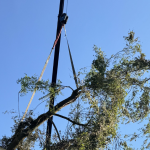
If you’ve got a large, valuable shade tree with a weak union – but you don’t want to lose the tree – the answer is often cabling and bracing. A pro installs steel cable between the two limbs (or between the trunk and a major limb) high in the canopy, taking load off the weak union. It’s not invisible up close, but from the ground it disappears, and it can save the tree for decades.
Cabling requires professional installation. The cable has to be sized correctly, anchored properly into sound wood, and inspected every few years. Don’t try to DIY this.
For cracked unions or codominant stems with visible failure
If the union is already cracking, or if it’s a codominant stem on a large tree near a structure, the safer move is usually to remove the weaker side or the whole tree. Cracks don’t heal. They get worse. And the failure usually happens during the worst possible storm of the year.
Why Spartanburg’s Summer Storms Are Especially Hard on Weak Unions
Carolina summer thunderstorms aren’t always the longest or the windiest storms of the year, but they hit hard and fast. The classic Upstate summer storm pattern – hot, humid afternoon, sudden buildup, microburst – is exactly the kind of weather that finds weak unions and breaks them.
Microbursts in particular are vicious. They’re sudden downdrafts of cold air slamming straight down from a storm cell, sometimes hitting 60 to 80 mph at ground level. A tree that handled steady wind fine for decades can have a major limb torn off in seconds when a microburst hits.
On top of that, summer storms come at peak leaf load. The canopy is full of leaves, which means more wind surface area and more weight when those leaves are wet. A weak union that survives winter wind with the canopy bare often fails in July with a full leaf load.
Get an Inspection Before Storm Season
The right time to find weak branch unions is before the next storm, not after. If you’ve spotted any of the warning signs above on your property in Spartanburg, Chesnee, or anywhere in the Upstate, get a real assessment from a professional.
Warrior Tree Service does free on-site inspections. We walk every major tree on your property, point out the structural concerns, explain what your options are, and give you a written estimate with a no-surprise guarantee on the price. Call (864) 660-7995 to schedule.
If a storm has already hit and a limb is hanging or down, we run 24/7 emergency service. Same number, day or night.